


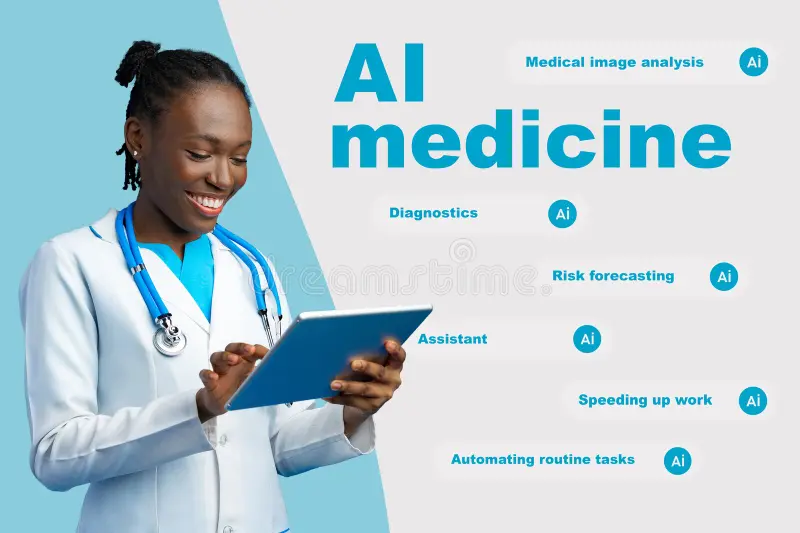
AI for Health Workers: Practical Artificial Intelligence for Modern Healthcare
Instructor
About This Course
Artificial Intelligence is rapidly changing how healthcare professionals work, communicate, learn, conduct research, manage information, and support patients. However, healthcare workers do not need to become computer programmers to benefit from AI. They need to understand what Artificial Intelligence can do, what it cannot do, how to communicate effectively with AI tools, and how to use these technologies responsibly within healthcare environments.
AI for Health Workers: Practical Artificial Intelligence for Modern Healthcare is designed to introduce doctors, nurses, midwives, pharmacists, laboratory professionals, allied health practitioners, healthcare administrators, public-health professionals, students, managers, and other health workers to the practical application of Artificial Intelligence.
The course begins with a simple explanation of Artificial Intelligence, generative AI, machine learning, large language models, and commonly available AI tools. Participants will then learn how to communicate effectively with AI through prompt writing and how to use AI to support everyday professional activities.
Practical applications explored in the course include drafting professional correspondence, preparing reports, summarising information, developing patient education materials, organising meetings, creating presentations, supporting research and literature review, generating training materials, analysing non-sensitive information, improving administrative efficiency, and supporting continuous professional development.
Special attention is given to the responsible use of AI in healthcare. Participants will examine important issues including patient confidentiality, data privacy, professional accountability, misinformation, inaccurate AI responses, algorithmic bias, ethical decision-making, and the dangers of relying on AI without professional verification.
The course emphasises that Artificial Intelligence is a support tool rather than a replacement for qualified healthcare professionals. Clinical decisions, diagnosis, treatment, prescriptions, and other high-risk healthcare decisions must remain under appropriate professional oversight.
Through practical exercises, examples, case studies, assessments, and workplace scenarios, learners will develop the confidence to identify appropriate AI applications within their professional roles.
By the end of the course, participants should be able to use Artificial Intelligence more effectively to save time, improve productivity, communicate more clearly, strengthen learning and research, support healthcare administration, and contribute responsibly to the digital transformation of healthcare.
No previous knowledge of Artificial Intelligence, computer programming, or data science is required.
Oliver Komi Mawunyo Aziator
Curriculum Overview
This course includes 1 modules, 2 lessons, and 1:00 hours of materials.
Artificial Intelligence is rapidly becoming part of modern healthcare. This introductory lesson explains why every health worker should develop basic AI literacy and how AI can support clinical, administrative, educational, research, and communication tasks. Learners will also be introduced to one of the most important principles of the course: AI should support healthcare professionals, not replace their professional judgement, responsibility, or human compassion.
simple
Quiz Certificate
Course Specifications
Subscribe to Our Newsletter


Additional Links
Login Register Contact Certificate Validation Become Instructor About Terms and PoliciesContact US


Reply to Comment